
Custom doesn’t mean guesswork.
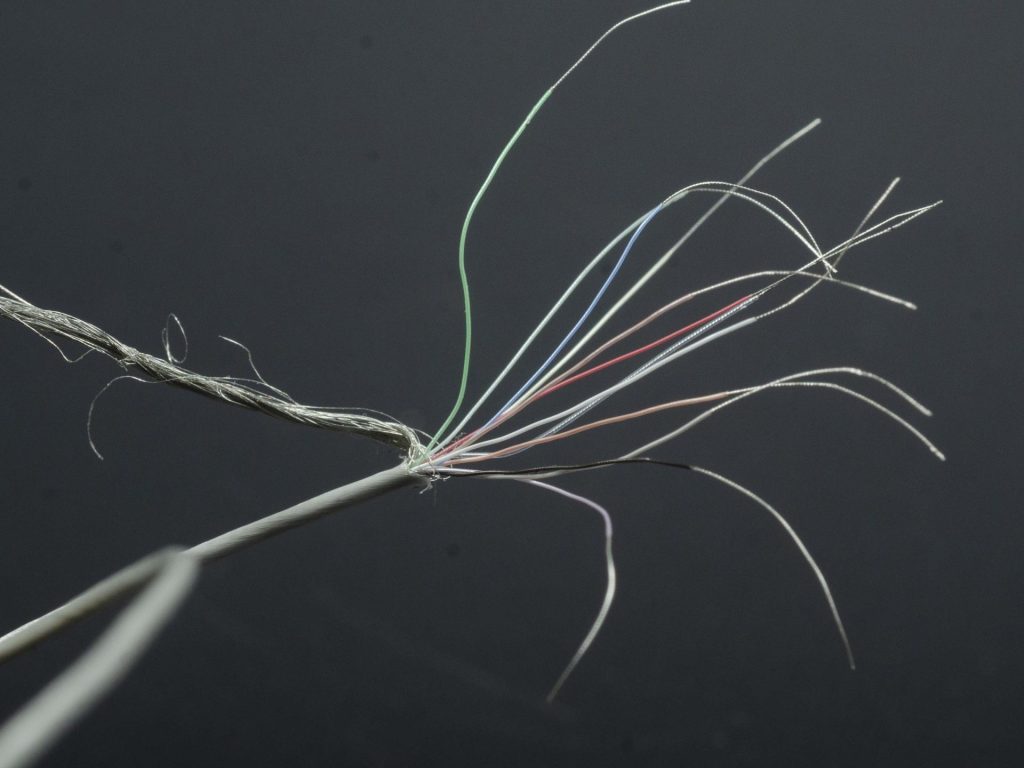
In endoscope camera systems, compatibility is not determined by module model name alone. Even for the same camera family (such as OCHTA10 / OV2740 / OV9734/OV6946), the correct endoscope camera cable build may differ depending on wiring/build details and integration requirements.
We help you reduce integration risk by combining:
- engineering-based compatibility checks
- custom prototype development
- prototype validation support
- scaling to mass production
Request a quote to develop the right prototype for your integration.
Why a custom prototype is needed
When the cable build doesn’t match the system integration, customers commonly face:
- Connector/termination mismatch (can’t connect or unstable fit)
- Image noise / unstable imaging
- Electrical signal abnormality / not working
A prototype is the most efficient way to confirm the cable works in your integration environment—before you scale production.
What you need to provide
| What you provide | Why we ask it | What you get from us |
|---|---|---|
| Camera module reference (e.g., OCHTA10 / OV2740 / OV9734) | baseline compatibility mapping | recommended build direction |
| Target cable length | manufacturing & system fit planning | prototype specification proposal |
| Any existing sample (preferred) or spec/drawing | reduces iteration risk | build confirmation approach |
| Requirements notes (no need for OD details) | selects the right construction & shielding approach | prototype build plan |
| Target quantity / timeline | production planning | mass-production feasibility alignment |
Engineering-based compatibility check
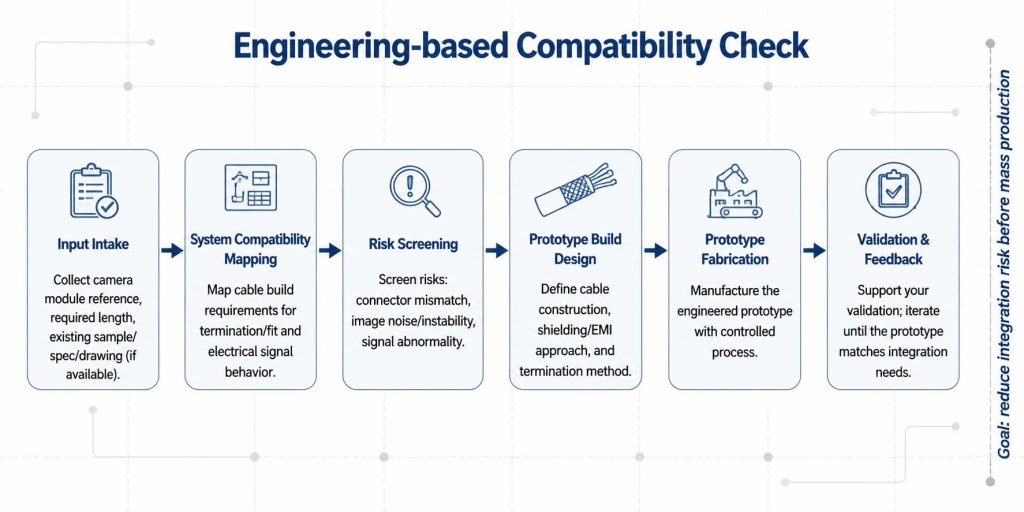
Before we build, we perform an engineering-based compatibility check using your inputs.
Our goal is to identify potential risks early and propose a cable build that can be validated quickly.
What we validate
- Fit & termination compatibility (connector/termination integration)
- Signal integrity behavior (to avoid abnormal signal issues)
- Imaging stability (reduce noise/instability risks)
- Integration feasibility (including installation considerations)
OD / pass-through constraints
In many installations, the cable must fit through an assembly path, which may involve space constraints (e.g., “too thick”, “can’t pass through”, “needs ultra-thin”).
You do not need an exact OD value to start.
If you can only describe the concern in simple terms, that’s enough. We will translate it into an engineering buildable direction.
Examples you can write:
- “can’t pass through”
- “too thick / tight space”
- “needs ultra-thin”
Custom prototype process
Our typical prototype development workflow:
- Requirements intake & mapping
- Cable build proposal & technical confirmation
- Prototype development (custom build)
- Prototype validation support
- Scale-up to mass production (after confirmation)
Timeline
- Custom prototype / sampling: 2–3 weeks
- Mass production: 3–5 weeks (after specification/prototype confirmation)
Risk reduction
| Common risk | What customers experience | How we reduce it |
|---|---|---|
| Termination / connector mismatch | can’t connect, unstable fit | review integration needs & termination approach |
| Image noise / instability | noisy or unstable imaging | shielding/build confirmation support |
| Electrical signal abnormality | abnormal signal / not working | wiring/build mapping & prototype validation |
| Installation feasibility issue | cable not suitable for routing space | accommodate practical constraints (even without exact OD) |
Compatible target modules
We regularly support custom endoscope camera cable development for projects involving:
- OCHTA10
- OV2740
- OV9734
- OV6946
If you’re working with these module references, send your details and we’ll guide you to the correct prototype build direction.
FAQ
Do I need to know the exact OD / diameter?
No. If you don’t have exact OD data, describe the practical concern (e.g., “can’t pass through”, “too thick”, “needs ultra-thin”). We will translate it into an engineering build direction for prototype.
If my module model matches, why might the cable still be different?
Because compatibility depends on integration requirements—wiring/build details, termination fit, shielding/EMI behavior, and real installation constraints. Module name alone cannot guarantee the correct cable build.
What if we only have an old cable and it doesn’t work?
That’s okay. If you can provide an original sample (or describe what failed), we can develop an engineered prototype plan to validate compatibility before scale production.
Can you support ODM and mass production after prototype?
Yes. Once the prototype build is confirmed, we support scaling to mass production within 3–5 weeks (typical after confirmation).
Ready to develop the right endoscope camera cable custom prototype for your integration?
Request a quote and share:
- camera module reference (OCHTA10 / OV2740 / OV9734)
- target cable length
- any sample/spec/drawing you have
- brief requirement notes (no need for exact OD)